Riverflow AI Credits Explained: What Each Image, Ad and Video Really Costs (2026)

Last updated: October 21, 2026. Prices are in USD and exclude VAT and sales tax.
Short answer: Riverflow charges in credits, and at base rates one image costs 10 credits, one static ad 25 and one video 40. Depending on your plan and billing cycle, that comes to roughly $0.11 to $0.17 per image, $0.27 to $0.41 per static ad and $0.43 to $0.66 per video. You can also get 20% off through our link.
Riverflow is an AI product photo generator for branded product photos, ads, and videos. So the real question is not just the monthly fee. It is how many assets you can make for that fee. This guide turns credits into cost per asset, shows which plan fits each workload, and lists the extra costs that do not always show up on comparison pages.
For a broader look at features and competitors, see our full Riverflow AI pricing, features and alternatives guide. If you are new to the tool, start with what Riverflow AI is and how it works.
Is the Starter plan still available?
Not for new customers. Since September 15, 2026, new users choose Growth, Scale, Business, or a custom Enterprise plan. The old Starter plan, with 2,250 credits for $39 a month, still shows up on many comparison sites, but it is no longer the entry plan. If you already have Starter, you should still be paying $39 a month.
The current plans at a glance
Growth costs $99 a month or $950 a year. It includes 6,000 credits, 3 Full seats, and 5 active brands. Scale costs $249 a month or $2,244 a year. It includes 16,000 credits, 10 Full seats, and 15 brands. Business costs $999 a month or $8,988 a year. It includes 70,000 credits, 25 Full seats, and 30 brands. Enterprise is custom. Viewer seats are unlimited on every plan.
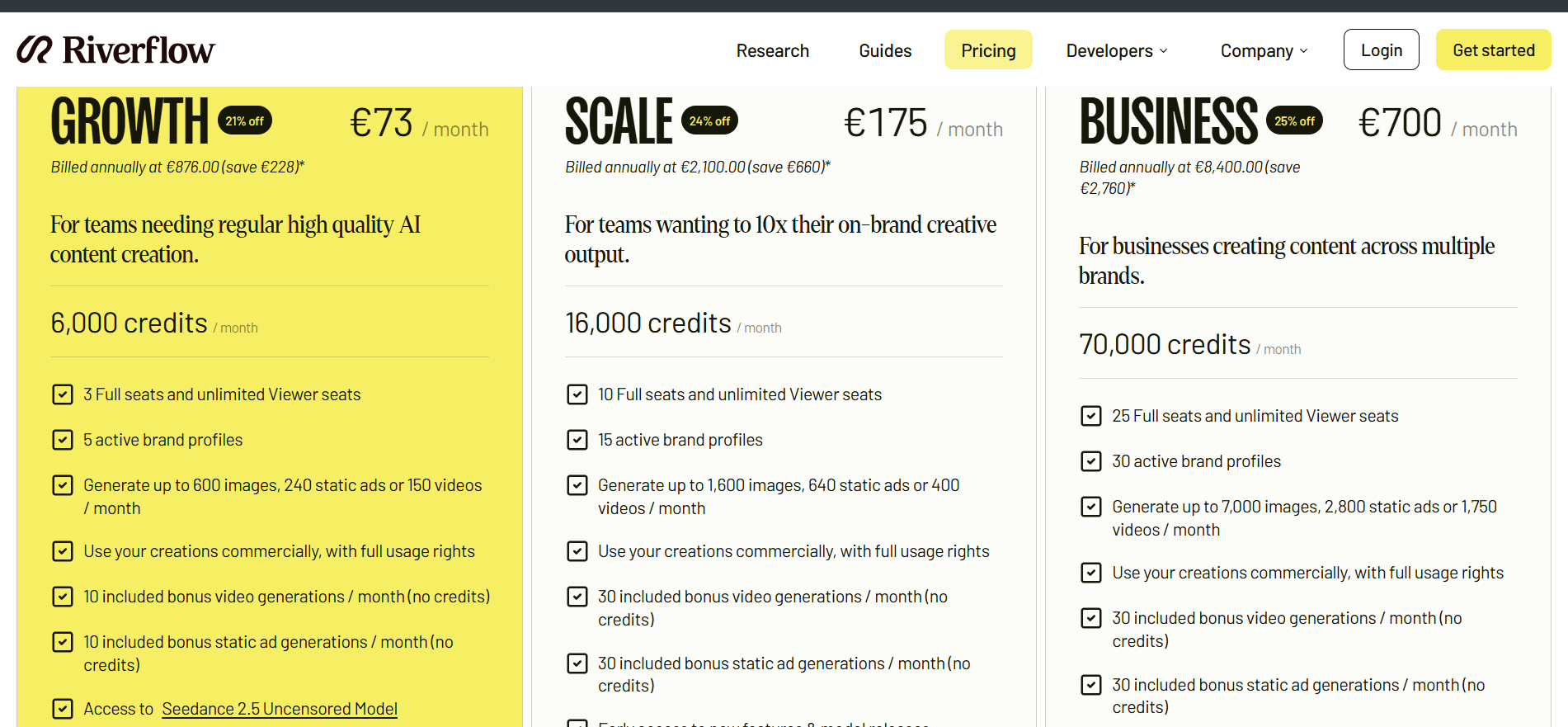
| Plan | Monthly | Annual | Credits / month | Full seats | Brands |
|---|---|---|---|---|---|
| Growth | $99 | $950 ($79.17/mo) | 6,000 | 3 | 5 |
| Scale | $249 | $2,244 ($187/mo) | 16,000 | 10 | 15 |
| Business | $999 | $8,988 ($749/mo) | 70,000 | 25 | 30 |
| Enterprise | Custom | Custom | Custom | Custom | Custom |
How Riverflow credits work
Credits are the same currency for every job. Riverflow shows the estimate before each generation, edit, video, ad, or batch job, so you know the cost first.
- Failed generations are refunded. If a generation ends in a failed state, the credits should come back automatically. A completed result you do not like is not a failure, so retries cost credits.
- Credits reset each month. The docs refer to your next monthly credit reset, and unused credits drop to zero when a subscription ends. It does not mention rollover, so plan on use-it-or-lose-it.
- Costs depend on setup. Consumption changes with the workflow, the model, your settings, and the number of outputs. Treat the numbers below as base rates.
How many credits does each action use?
Riverflow's comparison table lists how many of each output a plan allows. Divide a plan's credits by those allowances and you get the credit cost per action. The ratio is the same on Growth, Scale, and Business. For example, Growth's 6,000 credits cover 600 image generations, 240 static ads, or 150 videos.
Action | Credits (base rate) |
|---|---|
Image generation | 10 |
Image edit | 10 |
Product detail view | 15 |
Image upscale | 20 |
Static ad | 25 |
Video | 40 |
These numbers are my own math from the published allowances. They are not a published Riverflow rate card.
What each asset actually costs, by plan (illustrative estimates)
Divide each plan's price by its credits and you get the cost per credit. It is about $0.0165 on Growth monthly and about $0.0107 on Business billed annually. Multiply by the credit costs above to get the real cost per asset.
Plan and billing | Image | Static ad | Video |
|---|---|---|---|
Growth, monthly | $0.165 | $0.41 | $0.66 |
Growth, annual | $0.132 | $0.33 | $0.53 |
Scale, monthly | $0.156 | $0.39 | $0.62 |
Scale, annual | $0.117 | $0.29 | $0.47 |
Business, monthly | $0.143 | $0.36 | $0.57 |
Business, annual | $0.107 | $0.27 | $0.43 |
Two takeaways. First, annual billing lowers your cost per asset more than moving up a tier does. Second, moving from Growth to Scale saves only a few tenths of a cent per image at monthly rates, so upgrade for the seats, brands, and volume, not for a lower unit price.
These are best-case numbers. They assume every credit goes to one output type and there are no retries.
Bonus generations: free ads and videos
Some outputs do not use credits at all. Growth includes 10 bonus video generations and 10 bonus static ad generations each month. Scale and Business include 30 of each. At the monthly rates above, that is worth about $10 a month on Growth and about $28 to $30 on Scale and Business. If you use Riverflow as an AI static ad generator or AI video ad generator, spend these first.
Which plan fits your volume?

Here are three real workloads, based on the base rates above.
1. A Shopify store refreshing its catalog (Growth). Thirty products with five images each equals 150 images, or 1,500 credits. Add 60 static ads (1,500 credits) and 20 videos (800 credits), and you reach 3,800 of 6,000 credits, before the bonus generations. Growth is enough.
2. A performance team testing creative (Growth). One hundred static ads a month equals 2,500 credits. After 10 free bonus ads, you pay for 90, which is 2,250 credits. That leaves about 3,750 credits for roughly 375 extra images or edits.
3. An agency running 10 brands (Scale). A thousand images and 200 ads equals 15,000 credits, which fits inside Scale's 16,000. Growth would fail on both credits and brand count. It only allows 5 brands. Scale's 15 brand slots and 10 Full seats leave room to grow. Look at Business when you need 25 seats, 30 brands, or about 70,000 credits.
If your ads also need copy and angles, use a text model rather than Riverflow. If you are comparing Riverflow with Pebblely or another AI product image generator, check whether you need raw images or the full platform. See how the tools compare in Riverflow AI vs ChatGPT and Riverflow AI vs Claude, or browse other AI ad generators and our Google Ads generator.
Hidden costs and limits to check
- Extra seats and brands. Each extra Full seat or active-brand slot costs $39 a month, or $468 a year on annual billing. Extra users can add up fast.
- Top-ups. Growth, Scale, and Business offer on-demand credit top-ups, but Riverflow does not publish the price.
- Annual billing is upfront. Annual plans are paid in advance. The savings are $238 a year on Growth, $744 on Scale, and $3,000 on Business versus monthly billing.
- Cancellation. You keep your plan until the period ends. Remaining credits reset to zero, and generated assets stay available for 7 days after expiry. Download what you need before then.
- Taxes. Prices exclude VAT and local taxes, so your checkout total will be higher.
Riverflow credits vs paying through an API
Developers can also access Riverflow models through partners. Replicate lists Riverflow 2.0 Pro at $0.15 per 1K or 2K image and $0.33 per 4K image. That is close to the platform's $0.11 to $0.17 per image. The platform adds brand profiles, scenes, ad formats, editing, and team tools on top. If you only need raw image generation inside your app, the API may be the better fit. Check current rates for the newer 2.5 model before you decide.
Is Riverflow worth it?
It depends on how many branded visuals you need and how much consistency you want. Riverflow's public reviews are strong. It has a 4.7 out of 5 Trustpilot score across 42 reviews, with users praising output quality and onboarding support. The tool pays off when you need AI product photography, ads, or videos at scale. If you only make a few images a month, a plan that costs hundreds of dollars is hard to justify. If you are deciding which AI is best for pictures, compare lighter tools first.
How to get started
You can check live pricing and sign up on Riverflow's official pricing page with a 20% coupon.
Disclosure: The Raven Stack may earn a commission if you sign up through links on this page, at no extra cost to you.
FAQ
How many credits does a Riverflow image cost?
At base rates, an image generation or edit costs 10 credits. A static ad costs 25 credits and a video 40. The estimate shown before each job is the final word.
How much does one Riverflow image cost in dollars?
Between about $0.11 and $0.17, depending on plan and billing cycle, assuming no retries.
Is there still a Starter plan?
Not for new customers since September 15, 2026. New sign-ups choose Growth, Scale, Business, or Enterprise.
Is there a free plan?
The official pricing page currently lists none. Some third-party sites mention free credits, so check the sign-up flow for the latest.
Do unused credits roll over?
Riverflow's documentation describes monthly resets and does not mention rollover. Assume unused credits expire.
Can I buy extra credits?
Yes, on Growth, Scale, and Business. Prices are not published, so check your account.
Can I use the images commercially?
Yes. The pricing page says plans include full commercial usage rights.
What happens to my credits if I cancel?
You keep access until the end of the billing period. Remaining credits then reset to zero, and your assets stay available for 7 days.
Can I connect Riverflow to Claude or ChatGPT?
Yes, Growth, Scale, and Business all include MCP access to Claude, ChatGPT, and Codex.
Bottom line
Riverflow is cheapest per asset on annual billing, and bonus ads and videos lower ad-heavy costs even more. Pick the plan by volume, brands, and seats instead of headline price. Watch extra seats and brand slots, since they are the main add-on cost.